
The decision to hire an MC (Master of Ceremonies, also known as an emcee or event host) is often overlooked amid venue selections, catering, and entertainment bookings. Yet, for high-end events—corporate galas, luxury weddings, upscale private parties, or premium live entertainment experiences—this choice frequently determines whether an event feels polished and memorable or disjointed and forgettable.
At Event Live Entertainment, we specialize in curating immersive experiences with live bands and top-tier talent. Time and again, the differentiator between a solid gathering and an extraordinary one is the professional guiding the room: the MC. Hiring an MC isn’t about adding announcements—it’s about entrusting your event’s rhythm, energy, and emotional arc to a skilled orchestrator who ensures every element flows seamlessly.
This comprehensive guide explores why and how to hire an MC, the psychology behind their impact, integration with live entertainment like bands, pricing insights, common pitfalls, and a step-by-step process for securing the right professional. Whether planning a sophisticated corporate affair or a glamorous celebration, understanding MC services elevates your vision from good to unforgettable.
What Does It Actually Mean to Hire a Professional MC?
Hiring an MC means bringing in a professional who serves as the event’s conductor—directing attention, modulating mood, and maintaining momentum without overshadowing other elements.
One of the most overlooked aspects when you decide to hire an MC is how early their influence begins—and how long it lasts beyond the final moment of the event.
A great MC doesn’t just “show up and speak.” They shape the experience from the very first guest arrival to the final impression guests carry with them when they leave.
This is why choosing the right emcee for events is critical when combining live entertainment and structured programming.
If you want a deeper understanding of the role and responsibilities, you can explore our full guide on what do emcees do.
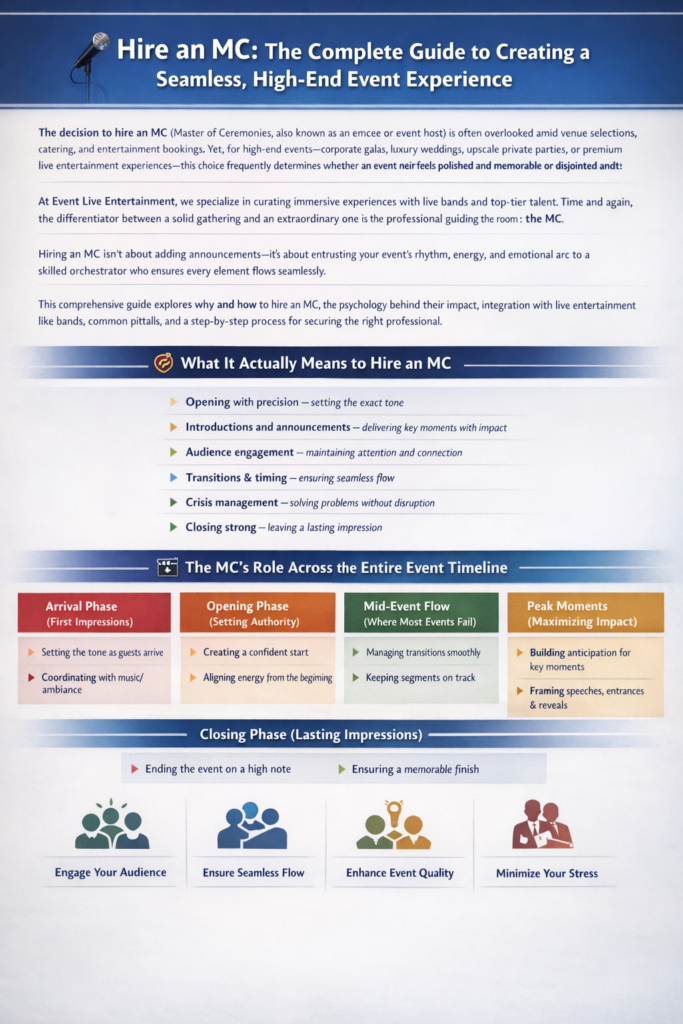
Arrival Phase (First Impressions)
As guests arrive, there is often a subtle uncertainty in the room. People are checking in, finding their place, and trying to understand the tone of the event.
A skilled MC sets that tone early—even before formally opening.
- Light interaction with early guests
- Coordinating with background music or live band ambiance
- Creating a sense of anticipation rather than confusion
This is where a professional MC begins establishing control without being intrusive.
Opening Phase (Setting Authority)
The opening moment defines everything that follows.
When you hire an MC, you’re ensuring that:
- Guests immediately understand the event’s tone
- There is no hesitation or awkward start
- Energy is aligned from the first minute
A weak opening creates uncertainty.
A strong MC creates confidence and attention instantly.
Mid-Event Flow (Where Most Events Fail)
This is where the majority of events break down.
Without proper guidance:
- Segments run late
- Speakers overlap or delay
- Energy drops between transitions
A professional MC prevents all of this.
They act as the invisible structure that keeps everything aligned, ensuring that guests never feel like they’re waiting or unsure about what’s happening next.
Peak Moments (Maximizing Impact)
Every event has key moments:
- A keynote speech
- A couple’s entrance
- A major performance
- A product reveal
A skilled MC builds anticipation leading into these moments.
They don’t just announce—they frame the moment so it lands with maximum impact.
This is one of the biggest differences you get when you hire an MC at a high level.
Closing (What Guests Remember Most)
The final impression matters more than most planners realize.
A great MC ensures:
- The event ends intentionally
- The message or feeling is reinforced
- Guests leave on a high note
Without this, even a great event can feel unfinished.
Without this guidance, even stellar content risks feeling fragmented. A professional MC transforms silence or confusion into intentional pauses, ensuring the audience remains immersed.
For deeper insights into responsibilities, resources like industry overviews highlight how MCs act as the “glue” holding events together.
The Psychology Behind a Great MC
Human attention spans are finite, and events involve shifting emotions—from excitement to reflection to celebration. A skilled MC leverages psychology to guide these shifts masterfully.
Key elements include:
- Attention control: Using vocal variety, pauses, and eye contact to direct focus precisely when needed (e.g., spotlighting a speaker or building anticipation for a band’s set).
- Emotional transitions: Seamlessly shifting from high-energy performance to thoughtful speeches or vice versa, preventing jarring drops that disengage guests.
- Energy management: Balancing hype with calm—knowing when to energize a crowd and when to let moments breathe for emotional impact.
- Building authority and trust: A confident, charismatic presence creates structure, making attendees feel secure and valued rather than lost in chaos.
In premium events, this psychological orchestration turns passive attendance into active participation, boosting satisfaction and perceived value.
Real-World Examples: MC + Live Band Synergy (Event Live Entertainment Style)
Live music elevates events, but without coordination, transitions between sets and other segments can falter. A professional MC bridges this gap, especially with premium bands.
Corporate Gala Example The band delivers a dynamic opening set, energizing the room. The MC steps in immediately—maintaining momentum with brief, enthusiastic commentary—then transitions smoothly to a keynote speaker. They monitor time, cue returns to music, and re-engage the audience post-presentation. Result: No awkward lulls; the event feels intentional and professional.
Luxury Wedding Example The MC times the couple’s entrance perfectly with the band’s swell, introduces them emotionally, coordinates speeches without rushing, and balances heartfelt moments with light fun. They ensure the band’s playlist aligns with the day’s rhythm—from romantic first dance to upbeat reception. Guests experience seamless emotional flow.
High-End Private Party Example The MC collaborates with the band to build energy progressively—announcing surprises, encouraging interaction, and filling gaps between sets without breaking vibe. The result is an immersive, high-energy atmosphere where music and hosting enhance each other.
This synergy—central to Event Live Entertainment’s approach—separates premium experiences from standard ones.
The Difference Between Good MCs and Exceptional MCs
Not all MCs deliver the same value.
When you hire an MC, you’ll generally fall into one of three tiers:
1. Basic MC (Functional)
- Can read a script
- Handles basic announcements
- Limited crowd interaction
Works for low-stakes events
2. Professional MC (Reliable)
- Strong communication skills
- Good timing and transitions
- Comfortable with live audiences
Suitable for most events
3. Premium MC (Transformational)
- Controls room energy effortlessly
- Integrates with entertainment (band, production)
- Enhances emotional experience
- Improvises naturally
This is where Event Live Entertainment operates
A premium mc for hire doesn’t just execute—they elevate.n creates a unified production where hosting amplifies entertainment.
Deeper Look: MC + Band Timing Dynamics
At high-end events, especially those featuring live bands, timing is everything.
Here’s what happens behind the scenes when coordination is done correctly:
Scenario: Transition from Dinner to Live Music
- The MC senses when guests are ready for a shift in energy
- Gives a short, engaging cue
- Signals the band
- The band starts at exactly the right moment
No delay. No confusion.
Now compare that to poor coordination:
- Guests are unsure what’s happening
- Band starts too early or too late
- Energy feels disconnected
This is why when you hire an MC, you’re also improving your entertainment performance overall.
Decision Framework: Do You Really Need an MC?
If you’re unsure whether to hire an MC, ask yourself:
- Does your event have multiple segments?
If yes → You need structure. - Does timing matter?
If yes → You need control. - Is guest experience a priority?
If yes → You need engagement. - Are you using live entertainment?
If yes → You need coordination. - Do you want a premium feel?
If yes → You absolutely need an MC.
Additionally, consider how much responsibility you or your team want to carry during the event. Without an MC, those tasks often fall on organizers, planners, or even guests—leading to stress and inconsistency. A professional MC centralizes that responsibility, allowing everyone else to focus on enjoying the event. If your goal is a smooth, elevated experience with minimal risk, hiring an MC quickly shifts from optional to essential.
Behind-the-Scenes Role of an MC
What most guests don’t see is often the most valuable part.
A professional MC is constantly:
- Communicating with event planners
- Adjusting timelines in real time
- Coordinating with audio/visual teams
- Syncing with performers
- Managing unexpected issues
They operate as a central communication hub.
Without them, responsibility gets fragmented across multiple people—which leads to mistakes.
The Cost of NOT Hiring an MC
This is rarely discussed, but it’s critical.
When you don’t hire an MC, you risk:
- Loss of audience attention
- Poor timing
- Awkward transitions
- Reduced perceived value of the event
- Increased stress for organizers
These issues often cost more (in experience quality) than hiring a professional in the first place.
How to Hire an MC: An Advanced, Step-by-Step Process
Hiring at a premium level requires strategy beyond basic searches.
- Define the desired experience: Ask what feeling you want—professional polish, emotional warmth, high-energy fun? Align this with event type.
- Prioritize performance over resume: Request videos of past events. Observe stage presence, timing, and crowd interaction.
- Check entertainment compatibility: For live band events, ensure the MC has experience collaborating with musicians. Ask about cueing and flow.
- Assess communication and fit: Conduct interviews or calls. They should grasp your vision, brand, and nuances (e.g., pronunciation guides, key messages).
- Collaborate on timeline and flow: Top MCs co-create run sheets, incorporating contingencies.
- Book early: High-demand talent (especially in markets like LA or major cities) fills quickly—aim for 6–12 months ahead for large events, 2–6 for standard.
Platforms, agencies, referrals, and portfolios help identify candidates. Always verify with references.
If your event is in a major market, working with a local specialist like an emcee in Los Angeles can significantly improve coordination and audience connection.
Pricing Breakdown: What to Expect in 2026
Premium MC services reflect expertise, risk reduction, and overall event impact. While pricing can vary significantly depending on the type of event, understanding the tiers helps you make a more informed decision when planning to hire an MC.
Entry to mid-range MCs typically charge between $300–$1,500, often suited for smaller or less complex events where basic structure and announcements are sufficient. These MCs can handle simple timelines but may have limited experience managing dynamic or high-pressure environments.
Professional, event-focused MCs—especially those experienced in weddings and structured private events—generally fall in the $1,500–$3,500 range for 4–7 hours. These professionals bring stronger stage presence, better timing, and the ability to adapt in real time. They are often bundled with DJ services, but standalone MC specialists tend to offer a higher level of control and engagement.
At the high end, corporate, luxury, or large-scale event MCs start around $5,000 and can go significantly higher, particularly when working with complex productions, live bands, or high-profile audiences. These MCs function as part of the production team, not just presenters.
Several factors influence pricing, including experience level, geographic location (with higher rates in major markets), event duration, complexity, rehearsal requirements, travel, and customization such as scripting or brand alignment.
Ultimately, when you hire an MC at a professional level, you’re not just paying for time—you’re investing in execution quality. A skilled MC prevents costly issues like disengaged audiences, timing breakdowns, or awkward transitions, delivering a strong return through a seamless and elevated event experience.
Common Mistakes When Hiring an MC (and How to Avoid Them)
Many organizers falter here:
- Treating the MC as an afterthought → Involve them early in planning so they can help shape flow and timing.
- Hiring based solely on price or without seeing them live → Always review videos, testimonials, and real event footage.
- Ignoring event-type fit → Corporate events require structure and professionalism; parties demand energy and interaction.
- Skipping coordination with entertainment → Confirm band/MC synergy to avoid awkward transitions.
- Overlooking adaptability → Choose someone comfortable improvising when plans change.
Another common mistake is failing to communicate expectations clearly. Even a highly skilled MC needs context about your audience, tone, and priorities. Sharing timelines, key names, and important moments in advance allows them to perform at their best.
Avoiding these ensures alignment, smooth execution, and a significantly better overall experience.
Corporate vs. Live Event MCs: Key Differences
- Corporate MC: Structured, brand-aligned, professional tone. Focuses on schedule, introductions, and clear communication (e.g., conferences, galas).
- Live Event MC (weddings, parties): High-energy, interactive, performance-oriented. Emphasizes engagement, humor, and vibe maintenance.
Mismatching types disrupts tone—select based on your event’s goals.
For business events specifically, working with a corporate event emcee ensures the right balance of professionalism, structure, and audience engagement.
The ROI of Hiring a Professional MC
Beyond logistics, benefits include:
- Higher audience engagement and retention.
- Smoother, more intentional flow.
- Enhanced brand/event perception as premium.
- Reduced organizer stress, allowing focus on strategy.
- Investing in professional event emcee services ensures your event runs smoothly while delivering a premium experience your guests will remember.
A great MC doesn’t manage—they elevate, turning good events into legendary ones.
When Should You Book an MC?
- Standard events: 2–6 months in advance.
- High-profile or peak-season: 6–12 months.
Demand for top talent is constant—early booking secures the best.
You can also review these event planning tips to better understand how structure and coordination impact overall success.
Final Checklist Before You Hire an MC
- Verified experience and portfolio?
- Style aligned with your vision?
- Clear communication established?
- Timeline and flow coordinated?
- Integration with entertainment (e.g., band) confirmed?
Tick these, and execution becomes seamless.
Deciding to hire an MC ranks among the most impactful choices for any high-end event. They deliver structure, energy, seamless flow, and confidence—especially when paired with live entertainment like Event Live Entertainment’s premium bands. A skilled MC ensures that every transition feels intentional, every moment lands with the right impact, and every guest remains engaged from start to finish.
Beyond logistics, an MC elevates the overall perception of your event. They create continuity between elements, reinforce key messages, and help shape the emotional journey of your audience. Whether it’s building anticipation, maintaining momentum, or closing on a high note, their influence is constant.
Don’t leave your event’s heartbeat to chance. Invest in a professional who transforms moments into memories. Your guests—and your vision—deserve nothing less.


